 Top Faith Senior Care
Elderly and Mental Health: How Companionship Prevents Senior Loneliness in Singapore
Learn how companionship supports elderly and mental health in Singapore by reducing loneliness, improving emotional wellbeing, and encouraging social connection
## Key Takeaways
- The elderly and their mental health are closely connected, with companionship playing an important role in emotional wellbeing and resilience.
- Senior loneliness in Singapore can develop gradually through reduced social interaction, changing routines, and prolonged periods of solitude.
- Meaningful social interaction often supports mood, confidence, motivation, and continued participation in daily life.
- Caregiver companionship and a supportive home environment may help seniors maintain familiarity, routine, and emotional stability.
- Early caregiving support, community engagement, and thoughtful care planning may help families respond before isolation becomes harder to reverse.
## Introduction
Ageing brings transitions. Retirement, reduced mobility, changes in social circles, and children moving into their own households can reshape daily life. Some seniors adapt comfortably to these changes, while others experience increasing isolation that develops quietly over time.
Today, growing attention is being placed on the relationship between the elderly and mental health. Emotional well-being in later life is shaped not only by medical conditions but also by social connection, routine, companionship, and feeling valued in everyday life.
In Singapore’s fast-paced urban environment, it is increasingly common for seniors to spend extended periods alone. Adult children often balance work, childcare, and caregiving responsibilities simultaneously, which can make consistent daily interaction difficult despite strong family relationships.
As Singapore’s population ages and more seniors remain independent for longer, conversations about emotional well-being have expanded beyond healthcare to encompass how families, communities, and caregiving support systems can work together to reduce isolation.
Programmes such as Senior Activity Centres, befriending initiatives, and community outreach efforts reflect a growing awareness that healthy ageing encompasses emotional and social well-being alongside physical health.
Understanding how companionship supports seniors allows families to take a preventive approach rather than waiting until emotional withdrawal becomes obvious.
## Why Elderly and Mental Health Cannot Be Viewed Separately
Mental wellbeing does not become less important with age. In many cases, emotional health becomes increasingly connected to daily structure, social belonging, and meaningful engagement.
For older adults, emotional wellbeing influences far more than mood alone. [It may affect motivation to stay active, willingness to eat regularly, participation in social activities, confidence in mobility, and engagement with hobbies](https://pmc.ncbi.nlm.nih.gov/articles/PMC7223173/).
Senior loneliness in Singapore often develops gradually.
It may begin with:
- Reduced social invitations
- Spending more time indoors
- Loss of familiar routines
- Fewer opportunities for conversation
- Hesitation to leave the house independently
Many seniors do not describe themselves as lonely. Instead, families may notice subtle changes such as:
- Less enthusiasm for hobbies
- Sleep disruptions
- Reduced appetite
- Increased irritability
- Lower energy levels
- Less interest in seeing others
These shifts can be easy to overlook, especially when a senior appears physically independent.
Supporting the elderly’s mental health, therefore, requires attention to everyday experiences, not only to health appointments or medical conditions.
## Understanding Senior Loneliness in Singapore
Loneliness and living alone are not always the same thing.
Some seniors enjoy solitude and maintain strong social networks. Others may live with family but still experience emotional isolation if interaction becomes limited or purely task-focused.
Several local realities contribute to feelings of alienation among the elderly:
### Retirement and Loss of Daily Structure
Work provides routine, purpose, and regular interaction. Retirement can remove all three simultaneously.
### Adult Children’s Busy Schedules
Many Singaporean households rely on long working hours, making daily companionship difficult despite strong family relationships.
### Reduced Mobility
Concerns about falling, fatigue, or transport challenges may gradually reduce participation in neighbourhood activities.
### Social Circles Naturally Becoming Smaller
As people age, friends relocate, develop health issues, or become less available.
Over time, reduced interaction may influence emotional resilience and confidence.
## Why Meaningful Social Interaction Matters More Than Casual Conversation
Companionship is not measured by the number of conversations someone has in a day.
A short exchange at the lift lobby may feel pleasant but does not necessarily provide emotional fulfilment.
What supports wellbeing more effectively is purposeful social interaction.
This often includes:
### Shared Routines
Simple habits such as morning walks, tea sessions, or preparing meals together help seniors maintain structure and predictability.
### Conversations That Feel Personal
Being listened to, sharing stories, discussing memories, and expressing opinions reinforces identity and emotional connection.
### Participating Instead of Observing
Activities become more meaningful when seniors contribute rather than simply watch.
### Maintaining Choice and Independence
Meaningful interaction respects autonomy rather than creating dependence.
These experiences help seniors feel recognised and connected to daily life.
## How a Supportive Home Environment Shapes Emotional Wellbeing
Home remains emotionally significant for many older adults.
A familiar neighbourhood coffee shop, void deck conversations, nearby walking routes, and long-established routines can provide comfort and stability.
An uplifting home environment goes beyond safety modifications or household convenience.
It may include:
- Daily companionship
- Predictable routines
- Opportunities to participate in household life
- Encouragement to stay socially engaged
- Respect for personal preferences
Creating this environment does not require constant stimulation.
Sometimes emotional support comes from consistency, familiarity, and simply having someone present.
## How Professional Caregivers Help Reduce Isolation
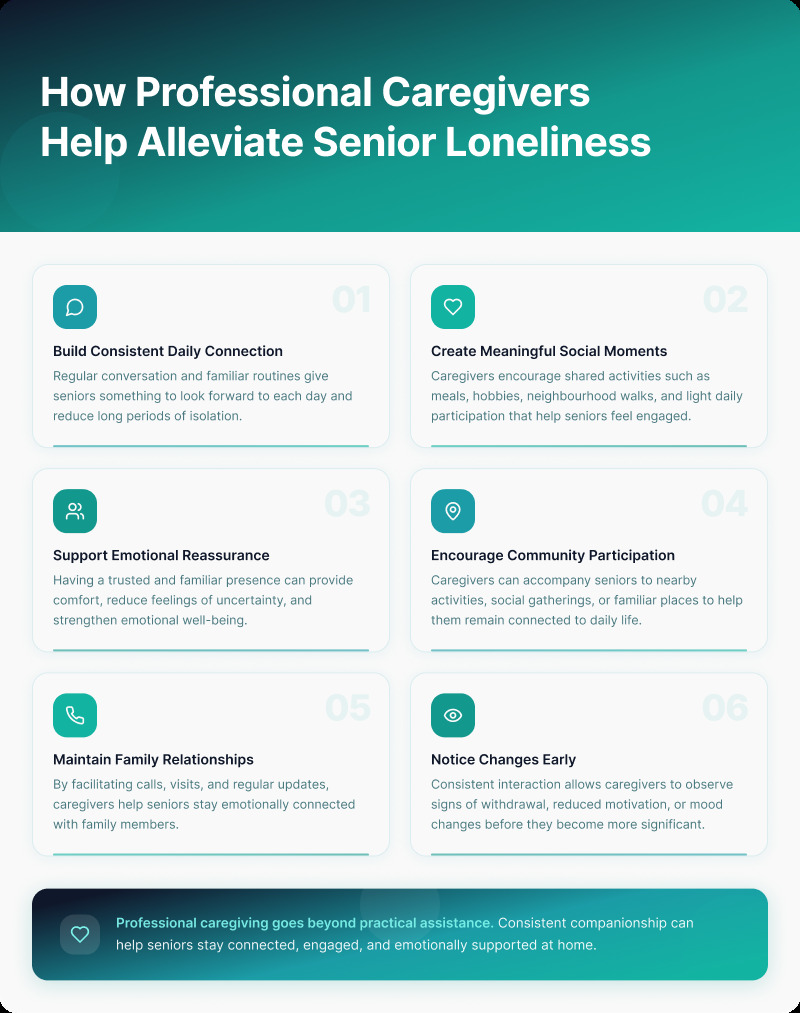
Caregiving is often associated with practical assistance, but companionship can also become an important part of daily support.
Professional caregivers may help by:
### Building Daily Rhythm
Structured routines reduce aimlessness and encourage continued participation in everyday activities.
### Encouraging Safe Social Engagement
Short neighbourhood walks, visits to familiar places, or attending local activities can help seniors remain connected.
### Supporting Family Connection
Caregivers can facilitate video calls, encourage communication, and help seniors maintain relationships.
### Observing Emotional Changes
Subtle behavioural changes may become more visible through consistent daily interaction.
This is where families may begin to explore [elderly caregiver services](/services/live-in-caregiver) as part of broader emotional and practical support planning.
It is important to recognise that caregivers are not mental health professionals. Persistent low mood, severe withdrawal, behavioural changes, or concerns about depression should still be discussed with healthcare professionals.
## Elderly Co-Living vs Ageing at Home: Which Supports Emotional Wellbeing Better?
There is no universal answer.
For some seniors, [elderly co-living](/services/senior-co-living) arrangements create valuable opportunities for peer connection, communal activities, and shared routines.
Potential benefits include:
- Built-in companionship
- Shared meals
- Reduced solitude
- Community engagement
However, others may prefer to remain in their own homes, surrounded by familiar neighbours, routines, and personal spaces.
For families comparing options, it can also be useful to understand how a [maid agency for elderly care](/services/live-in-caregiver) differs from specialised caregiver providers, particularly when companionship and emotional support are priorities alongside household assistance.
The right approach depends on:
- Personality
- Mobility
- Health status
- Social preferences
- Family availability
Both approaches aim to strengthen connection and reduce isolation.
## Community Support and Caregiver Companionship Work Best Together
Community initiatives remain valuable and accessible sources of connection.
Examples may include:
- Senior Activity Centres
- Befriending programmes
- Community outreach visits
- Neighbourhood events
These programmes create opportunities for social variety and connection.
Professional caregiving fills a different role.
Instead of occasional interaction, companionship becomes integrated into everyday life through routines, presence, and personalised engagement.
For many families, combining both approaches creates stronger emotional support than relying on only one.
## Why Early Support Matters More Than Crisis Response
Families often wait for visible emotional decline before introducing support.
However, companionship tends to be most effective when introduced earlier.
Early social support may help seniors:
- Maintain confidence
- Stay engaged in familiar routines
- Continue participating in community life
- Preserve independence
- Strengthen emotional resilience
Viewing the elderly and their mental health through a preventive lens encourages thoughtful support before isolation becomes difficult to reverse.
## Frequently Asked Questions
### Is loneliness common among seniors in Singapore?
It is increasingly recognised as an important concern, particularly for seniors who spend long hours alone or experience reduced mobility and social opportunities.
### Can a senior staying with family also experience loneliness?
Yes. Living with family does not always prevent loneliness. Limited conversation, different routines, or little daily engagement may still leave seniors feeling emotionally disconnected despite sharing the same home.
### Can companionship really influence emotional wellbeing?
Companionship cannot replace medical care, but regular social interaction and emotional connection may support mood, routine, and engagement.
### How do I know if my parent needs more social support?
Look for withdrawal from hobbies, reduced motivation, changes in appetite, reduced social participation, or visible emotional changes.
### Is home caregiving better than co-living?
Neither is universally better. The right option depends on personality, lifestyle, and the type of support a senior values most.
### Does every senior who lives alone become lonely?
No. Emotional well-being depends more on the quality of social connections than on household size.
## Conclusion
Emotional wellbeing is not a secondary part of ageing. Connection, routine, purpose, and companionship all shape how seniors experience later life.
Supporting the elderly and their mental health does not always require dramatic changes. Sometimes it begins with recognising small signs of withdrawal and creating opportunities for meaningful connection before loneliness deepens.
At Top Faith Senior Care, caregiving is designed to go beyond daily assistance. Founded by two experienced nurses with extensive experience in elderly care, Top Faith focuses on trained caregivers, AI-smart matching based on 25 household factors, secure access to caregiver profiles, and structured placement support managed by a MOM-licensed team. Caregivers also undergo Top Faith’s own preliminary assessment and training process to support both practical care and companionship.
[Contact us](/contact) if you notice changes in your parent’s social engagement, routine, or emotional well-being. We can help you explore personalised caregiving arrangements that provide companionship, preserve familiarity, and support your loved one as they age with connection and dignity.
← Back to all articles